PTFE conveyor belts
Say PTFE conveyor belt,
hear Hardick, and vice versa
Hardick PTFE conveyor belts are successfully used in the production of food, solar panels, beverage cans, floor mats, carpets, flooring, nonwovens, paper, screen printing, insulation products, extruded rubber profiles, plastics, composites, and much more.
We supply our belts tailored to unique specifications for end-users in all of these industries. Machine builders in all these sectors also find their way to Hardick.
We have answered the questions ‘how can I achieve a non-marking PTFE joint?’ and ‘how can I achieve perfect cooperation between PTFE and the glass or aramid fabric?’ once and for all. The same applies to the growing demand for wider conveyor belts. With our experience and the facilities to produce PTFE conveyor belts in practically any width, we contribute to the optimization of a wide variety of production processes on a daily basis.


Innovative properties for
optimal production
PTFE coated materials are sought after in industrial processes due to their excellent non-stick properties. The coating ensures that products easily release from the PTFE conveyor belt without sticking, which increases efficiency and reduces maintenance costs. The unique chemical structure of PTFE, also known by the brand name Teflon, results in an extremely smooth surface. This is due to carbon-fluorine bonds that do not adhere to other materials. The smoothness minimizes friction and facilitates cleaning. Additionally, PTFE is resistant to high temperatures, making it a durable and effective non-stick coating.
PTFE glass fabric combines the heat resistance of PTFE with the durability of fiberglass. This material can withstand extreme temperatures up to 260°C (500 F) while remaining flexible and stable. The PTFE coating provides excellent non-stick properties, while the fiberglass contributes to strength and durability. As a result, PTFE glass fabric is ideal for applications where heat resistance, chemical resistance, and non-stick properties are required, for example in industrial ovens, food preparation and packaging machines.
PTFE has an extremely low coefficient of friction, making the material ideal for applications where a smooth flow is essential. The unique chemical structure results in smooth surfaces with minimal resistance, which minimizes friction. As a result, PTFE is widely used in machine parts, sliding elements and lubricants for efficient operation.
PTFE glass fabric exhibits excellent chemical resistance thanks to the combination of PTFE and fiberglass. This material withstands corrosive substances, acids and chemicals, making it ideal for environments with aggressive chemical processes. The durability and integrity of PTFE glass fabric remain intact, even with prolonged exposure to various chemicals. This property makes the material suitable for a wide range of applications where chemical resistance is essential.
PTFE glass fabric offers impressive tensile strength thanks to the combination of PTFE and fiberglass. The tensile strength of glass is much higher than that of steel. The coated material is resistant to tearing, abrasion and mechanical stresses, making it durable and reliable for various applications. The PTFE coating and the fiberglass together provide exceptional strength and stability
PTFE glass fabric is highly suitable for the food industry due to its excellent chemical resistance, non-stick properties, and heat resistance. This material can safely come into contact with food and meets high hygiene standards. Due to its durability and reliability, PTFE glass fabric is ideal for applications such as baking, cooking and food processing.
Superior custom PTFE conveyor belts for every application
Each PTFE belt we deliver is custom made to the user’s specifications and demands. We provide advice on the material, edging, and joint when necessary. After receiving the order, we produce the teflon belt and have it ready for shipping within 2 working days.
The material of a conveyor belt is the most important element. All our conveyor belts are made from PTFE coated fabrics. We primarily use glass fabrics, but also aramid fabrics. For added stability, optimal release, abrasion resistance, and a longer lifespan, we can design the belt according to specific requirements.
We supply belts with a length of over 150 meters, as well as those measuring only 12 centimeters. We offer belts with a maximum standard width of 5200 mm, but if necessary, we can produce them even wider.
Standards en Specials
We supply closed surface conveyor belts, with a thickness ranging from 0.08 mm to 1 mm. Depending on the application, we work with our customers to choose either a smooth surface or a textured one. We have developed various fabrics that meet different requirements, such as minimal elongation, improved stability, and better delamination values.
Our mesh belts can be made up to more than 5200 mm wide. We provide PTFE-coated glass, aramid, or aramid/glass belts in meshes from 1×1 to 8×8 mm.
Whether it’s a PTFE or PFA top layer on a standard fabric for better release or a 2-ply laminate with a smooth surface, we can produce it to your specifications in our factory.
PTFE mesh belts

Closed PTFE conveyor belts

Laminated belts

Contact us
Edge reinforcement
High flex edging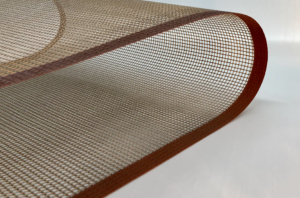
High flex is a thin modified PTFE film that is very flexible and durable. Our standard edge reinforcement for mesh belts is 20 mm wide black or brownred.
PTFE film edging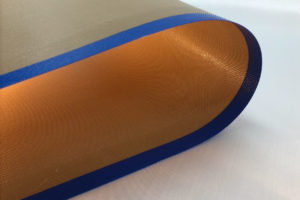
Closed belts only get an edge reinforcement when the sides need to be sealed of. We use our thin blue or transparant PTFE film for these types of belts.
Kevlar edging 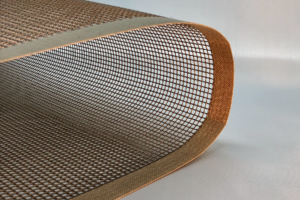
An edge made out of PTFE coated kevlar fabric can be applied in several widths. This robust edge proves itself on wide PTFE mesh belts.
Tracking cord 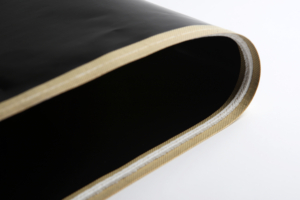
A PTFE conveyor belt needs a method of tracking or guiding to run. A tracking cord is an option for belt guiding.
Studs 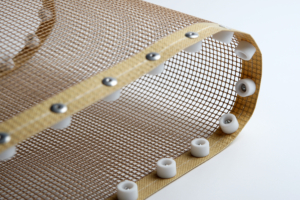
Studs can help guide a PTFE conveyor belt. The PTFE, stainless steel of brass studs run through grooves on the rollers and keep the PTFE belt aligned.
Eyelets 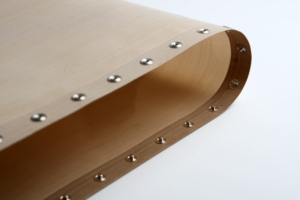
PTFE conveyor belts can be mounted between two chains and guided accordingly. The chains connect to the belt with springs and eyelets.
Contact us
Joints
Butt joint 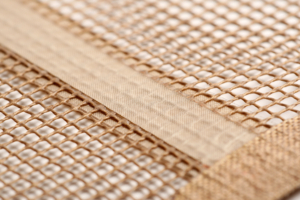
In a butt joint both belt ends are joined without overlapping. The strength and thickness depend on the top and bottom plasters that are used.
40×8 finger joint 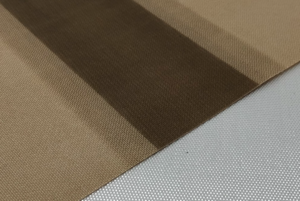
Our finger joints have been developed to perfection. From a joint that is only 70 µm thicker than the belt to a wear-resistant non-breaking joint.
H7 rubber extrusion joint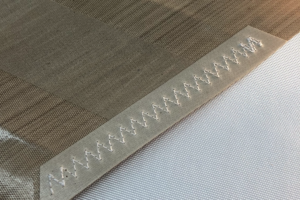
When the oven temperature is extremely high, the joint in the belt needs to be able to cope with that. This type of joint is specifically designed for high temperature processes.
Overlap joint 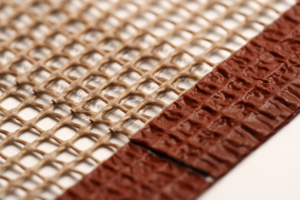
An overlap joint is the easiest joint in a PTFE belt. Both belt ends are overlapped and sealed with only a thin sealing film in between.
Castellated joint 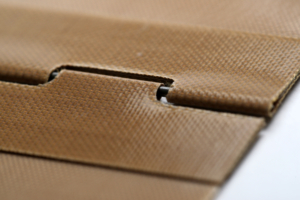
The castellated joint is completely made of PTFE coated fabric. Product on the belt does not get in contact with any other material.
5×7 finger joint 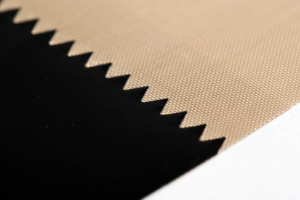
Our 5×7 finger joint has small fingers that are easily assembled. This finger joint has no straight breakline and provides extra durability compared to a butt joint.
Bullnose joint 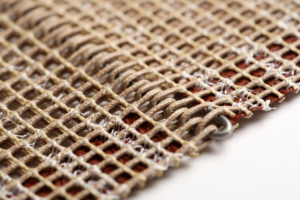
The bullnose joint is the standard joint for PTFE mesh belts. It allows for an air flow through the belt. The bullnose can be sewn around the belt ends as an envelop but also underneath, ensuring a smooth surface.
PEEK spiral joint 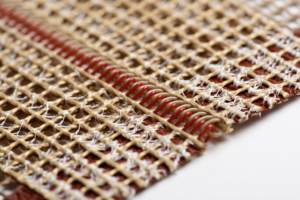
Our PEEK spiral joint is an air permeable joint used for PTFE mesh belts. With increasing width of the belt, we select a more robust build up.
A36 metal clipper joint 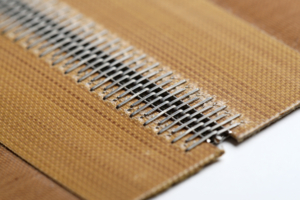
The A36 metal clip joint somewhat resembles a zipper. The metal clipper is pressed into both reinforced belt ends. These ends perfectly fit in each other once the belt is in the machine.
A36 metal clip joint with cover flap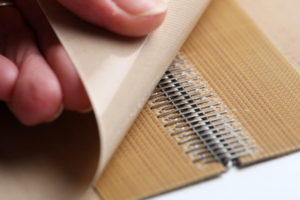
In some processes a cover flap is desirable to shield the metal clipper from machine parts or product. Either to prevent wear marks on the machine or the product sticking to the joint.
Advantages and properties of our PTFE conveyor belts
- Temperature resistant from -70°C up to 260°C (-94 to 500 F).
- Extremely low friction (0,05).
- Excellent anti adherence properties.
- Superior chemical resilience.
- Low heat capacity (1.000 J/kg·K) and heat loss.
- High strength (up to 10.000 N/5cm) at very low thickness.
- No need for solvents on the belt.
- No fungal or bacterial growth.
- Lightweight constructions possible for ovens and furnaces.